Most students have to study Shakespeare in high school. But it can be tough figuring out what he’s actually saying!
Here are my tips on how to decode, decipher and comprehend the complicated sentences in Shakespeare, or any other difficult literature you may read. We’ll use one of my favourite plays, Twelfth Night, as an example.
UNDERSTAND THE CONTEXT
Look at the plot summaries and list of characters, so you understand what is supposed to be happening.
TAKE NOTES IN THE TEXT
Write down your interpretations of the sentences as you work them out.
Note any unusual vocabulary with connotations.
LEARN OLD-FASHIONED WORDS
Shakespeare and other classic writers often used words which we don’t use now. A list of some common ones are below.
Some common ones:
Thou – you as subject
Thee – you as object
Thy – your
Thine – your
Whence – where
Wherein – therefore
Then there’s words that have ‘st’ or ‘t’ added to the end of them. Just ignore the extra letters. ‘Shalt’, for example, just means ‘shall’.
And finally, Shakespeare was creative to get words to fit his iambic pentameter. Sometimes he smooshed words together. If you see words joined together with apostrophes, with some letters missing, it is probably the most common words or letters.
In an example from Act 1, Scene 1 of Twelfth Night, Duke Orsino describes falling in love with Olivia:
That instant was I turn’d into a hart;
And my desires, like fell and cruel hounds,
E’er since pursue me.
Here, the apostrophes in “turn’d” and “e’er” stand in for a single letter. Turn’d or turned. E’er or ever. Shakespeare does this to make sure both words are one-syllable and so fit the metrical scheme of his passage.
BREAK APART THE SENTENCE
1.Identify the beginning and end of the sentence. In Shakespeare, capital letters and line breaks tell you nothing. Look for the words between two full stops.
2. Divide up the sentence according to the major punctuation marks. The most significant after the full stop is the semi-colon. The clause before the semi-colon is a complete sentence with a subject and verb; the clause afterwards also has a subject and verb.
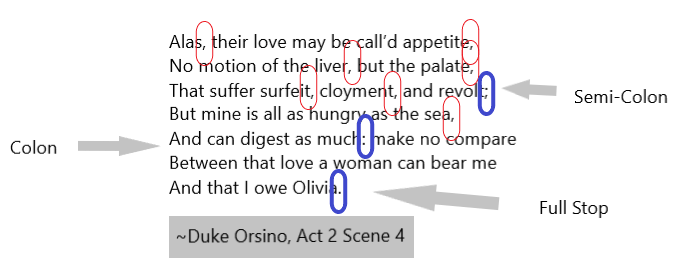
In this example from Act 2 of Twelfth Night, Duke Orsino’s sentence covers seven lines and includes both a colon and a semi-colon.

3. Identify the subject. This must be a noun; look at surrounding sentences for clues.
In the above example, the sentence’s subject is ‘their love’ in the first clause before the semi-colon, and ‘mine’ (love) after the semi-colon. After the colon, there is an unstated subject ‘you’, who is the one who Orsino is telling not to make comparisons.


4. Identify the main verbal phrase. This is what the subject is doing. Note it may well be a phrase, not just one word. Distinguish the verbal phrase from additional information and adjectives.
In the above example, ‘their love’ in the first independent clause ‘may be called’ something. (It is a passive verbal phrase.) ‘Their love’ also ‘that suffer’ something.
In the second independent clause (after the semi-colon), ‘mine’ (love) ‘is’ something, and ‘can digest’. (Is is a verb!)
Finally, after the colon, the instruction made to the unstated ‘you’ is to ‘make no compare’.


5. Link the main parts of the sentence (subject, verbal phrase, object, additional information) with any conjunctions in the sentence.
In the above example:
Their love may be call’d appetite,
No motion of the liver, but the palate, (additional information)
That suffer surfeit, cloyment and revolt;
But mine [love] is all as hungry as the sea,
And can digest as much:
[You] make no compare
Between that love a woman can bear me
And that I owe Olivia.
TRANSLATE INTO MODERN ENGLISH
Finally, try rewriting the sentence into modern English without changing the sentence structure too much. This helps you get used to the meaning of the sentence structure.
In the above example:
Their love could be called hunger,
Not from their liver, but from their taste buds,
And so they can have enough, too much, and turn to revulsion;
But my love is as hungry as the huge sea,
And can have as much as the sea can have:
Don’t compare
The love a woman could feel for me,
And the love I feel for Olivia.
CONCLUSION
After all this work, you should have a passage which you understand. Make sure to take plenty of notes so that when you come back to this passage, you can quickly understand it, and use it if you wish.
Remember that for Shakespeare, just knowing what the plot is, and the actual statements the characters say, is just the beginning. You also need to interpret the plot and statements in terms of the major elements of a story – theme, character, plot, and setting. You also need to look at how the elements are expressed through the use of language features and other rhetorical devices. But more on that later!
Discover more from Angela's Guide to English Literature
Subscribe to get the latest posts sent to your email.

 Angela's Guide to English Literature